
Stop Drawing Blueprints for a Moving Skyline
Why is transformation a learning journey, and why do most journeys break?
Image generated by Chat gpt
Let’s start with a small reality check. Remember the last big transformation you lived through? A bold destination, a three-year timeline, a financial target with a comma in it, and forty initiatives colour-coded on one heroic slide. Everyone applauded. And then? By September the AI landscape had shifted twice, a new tariff wall had appeared, and half of those initiatives were chasing a destination that no longer existed.
Sound familiar?
Nobody failed, exactly. The plan did. Or rather, the idea of a plan did.
This is the uncomfortable message of Evgeny Kaganer and Christoph Loch in their new HBR piece, “Transformation Should Be a Learning Journey.” Their diagnosis is short and not very sweet: most transformations fail because they are run as “fixed, top-down programs with predefined goals, timelines, and financial targets.” Their cure is braver. Treat transformation as “an evolving process in which strategy, priorities, and even the destination are continually refined.”
Even the destination. I can already hear a few steering committees choking on their coffee. Change the destination? Isn’t that exactly what we pay leaders not to do? Well, let’s see.
So what replaces the blueprint?
Kaganer and Loch swap the construction project (blueprint, scaffolding, ribbon-cutting) for something any investor would recognise: a portfolio. They sort transformation work into four initiative types that “together generate critical learning and sustain momentum.”
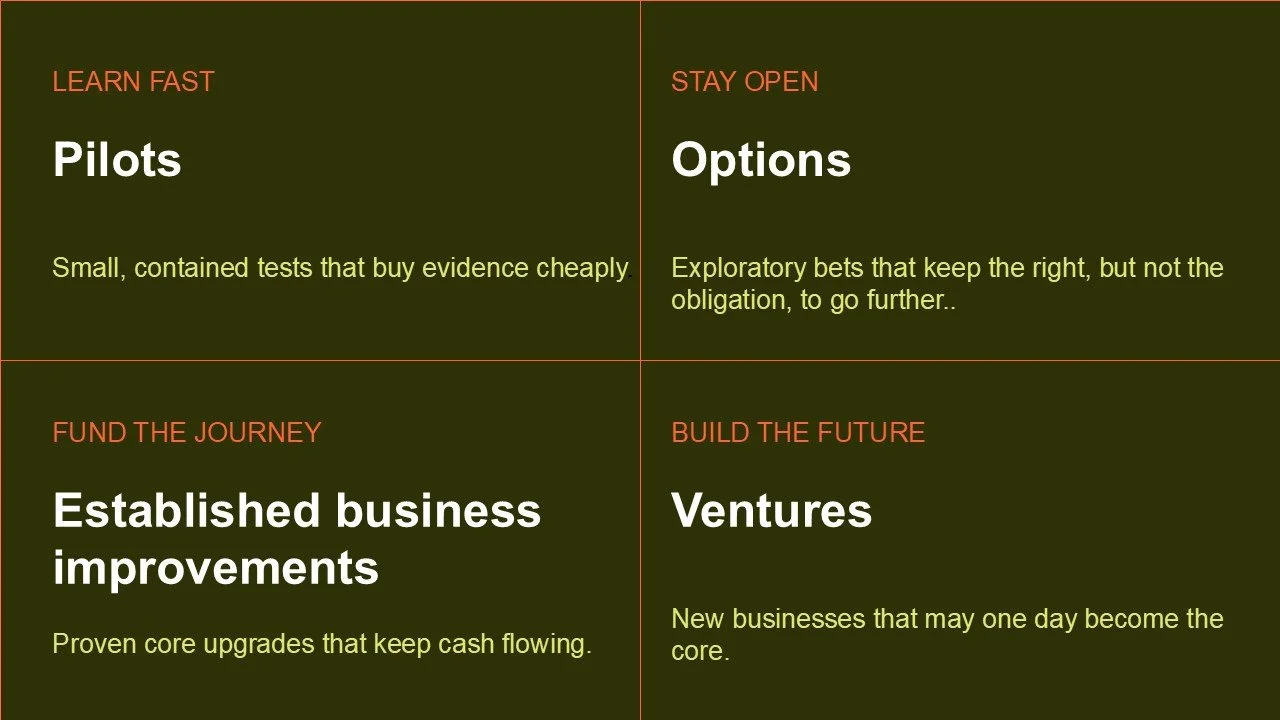
Transformation work initiatives - Adapted from Kaganer & Loch article
No serious investor bets the whole fund on one asset with a fixed exit date. You balance cash cows with growth bets and cheap options, and rebalance as information arrives. Simple, isn’t it? On paper, yes. In practice, a portfolio only creates value if what one part learns can change what the rest does. And this is exactly where most transformations lose the plot. In two places.
Why do good pilots die in the corridor?
Here is a rule I have seen confirmed more often than I would like: pilots are wonderful at generating learning, and institutions are wonderful at destroying it.
In From Experiment to Institution: Why Innovation Fractures When It Scales, I argued that successful experiments rarely die in the lab. They die at the handoff. Scaling strips away the conditions that made them work: the autonomy, the tolerance for ambiguity, the small team that could change its mind on a Tuesday. Handed to a business unit with quarterly targets and a risk committee, within months the thing that worked has been politely sanded down into something that fits.
Kaganer and Loch’s framework makes this handoff unavoidable. Pilots and options are supposed to graduate, and every graduation moves an initiative from a world that rewards learning to one that rewards predictability. No plan for that crossing? Then expect a steady stream of brilliant pilots and very little transformation. Plenty of confetti, no cake.
Why does nobody next door know what you learned?
The second failure is quieter, and just as expensive. In Innovation Dies in Silos, we looked at insight that never leaves the room where it was born. One team discovers something precious; the team next door, fighting the same problem, never hears about it.
A transformation portfolio multiplies that risk: four initiative types, four rhythms, often four executives with four dashboards. If a pilot in one market finds that customers won’t pay for a feature, the venture team three floors up should know by Friday. Not at the annual offsite, somewhere between the keynote and the dinner.
HBR’s companion tip on keeping a transformation on track recommends building a coordinated portfolio and explaining, again and again, how the pieces connect. Good advice. I would add one small condition: coordination means routing evidence between projects, not only aligning them to a vision. Otherwise you have several fixed programmes running in parallel, with a nicer name.
Doesn’t changing course make leaders look weak?
It can. Revising the destination is strategically sound and psychologically brutal. But the cure for whiplash is not rigidity. It is a story. “We changed course because our pilots in three markets showed us X” builds trust. “We’re pivoting,” full stop, burns it. And here is the catch: leaders can only tell the first story if the learning survived the handoff and actually travelled.
So what do you do on Monday morning?
Three things.
Design the handoff on day one.
Every pilot launches with a graduation plan: who owns it if it works, and which protective conditions travel with it. No plan? Then it is a science fair project, not a transformation initiative.
Build routes for evidence, not just reports.
Shared learning reviews, people who rotate between pilots and the core, a searchable record of what each experiment showed. Status reports travel upward. Learning needs to travel sideways.
Measure learning velocity, not only delivery.
How many important decisions this quarter were changed by evidence from your experiments, or another unit’s? If the answer is zero, your portfolio is decoration.
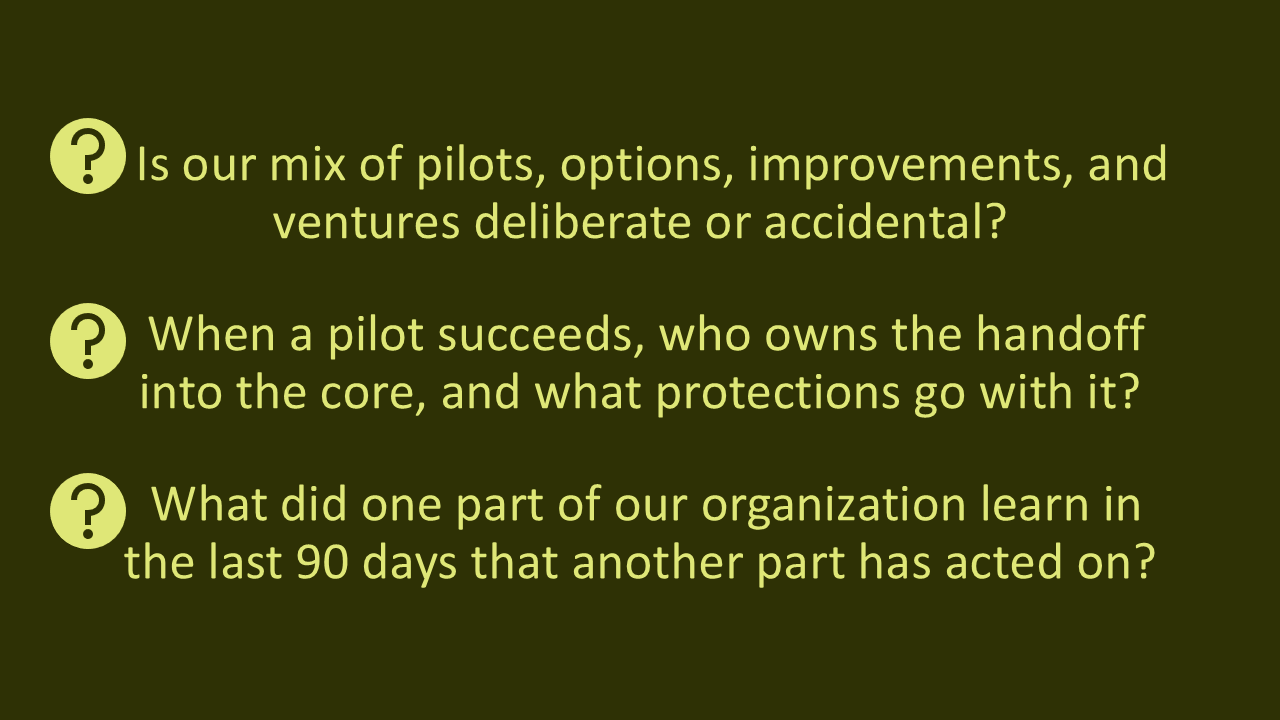
Three questions to bring to your next leadership meeting
Blueprint or expedition?
Cathedral builders could afford blueprints because the ground stayed still for centuries. Today’s leaders are leading expeditions across terrain that redraws itself every quarter. On an expedition, the map matters less than the scouts. But scouts are only useful if they make it back to camp, and what they saw reaches everyone.
So, to sum up. Kaganer and Loch are right: transformation should be a learning journey. The leader’s job is to make sure the learning survives two crossings, from experiment to institution and from one silo to the next. It is not rocket science. But it does take discipline.
